While developing AI applications, I encountered a key challenge: although model capabilities are constantly improving, enabling AI to access real-time, accurate data remains a difficult hurdle.
This is particularly true when building RAG (Retrieval-Augmented Generation) systems; the most time-consuming part is often not calling the model itself, but the initial data preparation. Webpages—containing documents, product specifications, and technical content—are often cluttered with irrelevant information that can compromise retrieval performance if fed directly into an AI system.
I previously tried building my own web scraping pipelines, but maintenance costs skyrocketed as the projects grew.
Later, while building AI knowledge bases and automated agents, I started using Firecrawl. It helps developers efficiently acquire web data optimized for LLMs, minimizing the need for complex data cleaning and maintenance.
Step 1: Getting Started with Firecrawl
Getting started with Firecrawl is simple: just visit the Firecrawl website, sign up for an account, and obtain an API key.
Once the basic setup is complete, developers can integrate web data scraping capabilities directly into their AI projects.
This process is highly accessible for those just beginning to build RAG applications. Compared to building a crawler from scratch—handling parsing and various edge cases—Firecrawl offers a more straightforward solution, allowing developers to quickly move on to the actual AI application development phase.
Scraping Web Content: Making Data Truly AI-Ready
In my actual projects, I use Firecrawl most frequently for scraping web content.
Many enterprises want to integrate their product documentation, help centers, or technical materials into an AI knowledge base, but simply copying and pasting webpage content rarely yields good results.
The reason is simple: webpages are designed for humans, not for AI.
When users view a webpage, they naturally ignore elements like menus, buttons, and decorative graphics. However, for an AI system, this extraneous content might enter the data processing pipeline, negatively affecting subsequent steps like embedding generation and vector database retrieval.
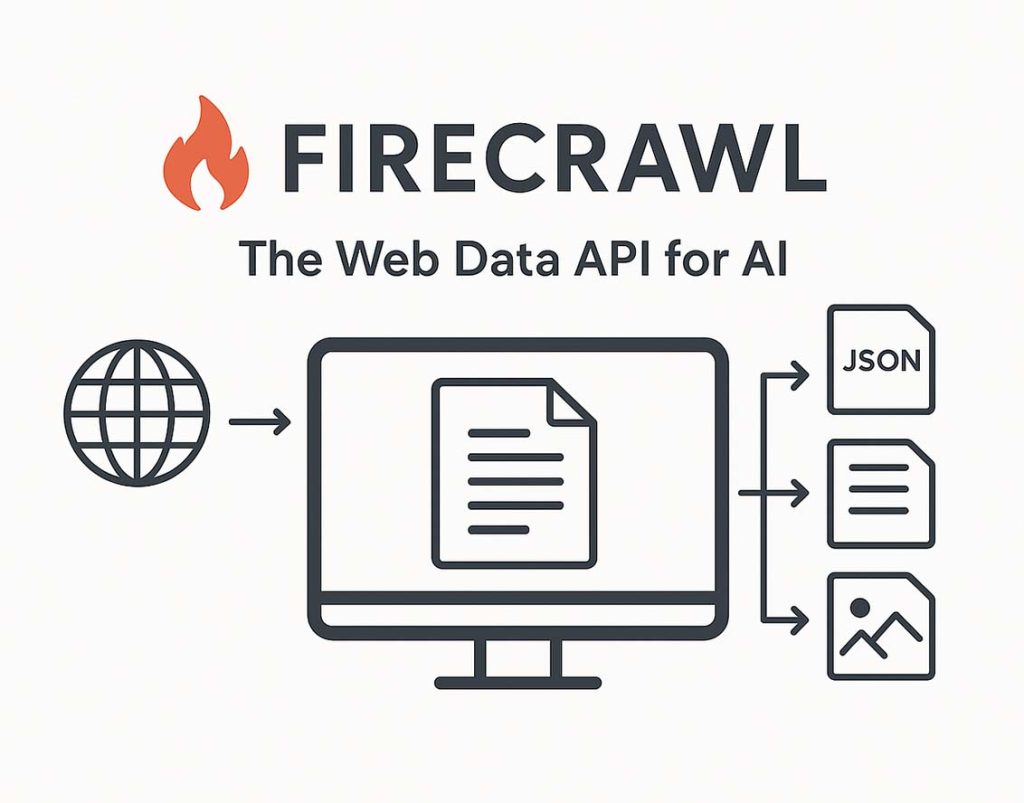
Firecrawl helps developers extract the core content from webpages and convert it into formats that are easier for LLMs to understand, such as Markdown.
Data processed in this way is much better suited for RAG systems, enabling the AI to access clearer, more valuable information.
Building Enterprise AI Knowledge Bases with Firecrawl
As AI applications evolve, an increasing number of enterprises are looking to build their own AI knowledge bases. For instance, a SaaS company might possess a vast library of help documentation, product guides, and API references. To enable an AI assistant to comprehend this material, these web-based resources must first be converted into machine-readable data.
In the past, development teams typically had to maintain their own data ingestion pipelines for this purpose. However, as website content is constantly updated, the maintenance burden grows increasingly heavy.
Firecrawl enables developers to rapidly retrieve website content and seamlessly integrate that data into downstream AI workflows.
In my own projects, I typically process the data retrieved by Firecrawl further, connecting it to embedding models and vector databases to build an AI system capable of answering user queries.
When a user asks a question, the AI is no longer limited to its pre-existing knowledge; instead, it can generate more accurate answers based on the enterprise’s own proprietary data.
The Search function helps AI access broader information from the internet
Beyond simply scraping specific web pages, Firecrawl is also ideal for scenarios requiring real-time information retrieval.
For example, when developing an AI research agent, the system might need to locate information from multiple sources, then analyze and summarize it.
Traditional methods require handling search, web scraping, and content parsing separately, whereas Firecrawl streamlines this entire process.
For tasks such as market research, competitive analysis, and industry intelligence gathering, this capability significantly boosts data collection efficiency.
This represents what I believe is a crucial aspect of the future of AI applications: enabling AI to move beyond merely answering based on existing knowledge and instead actively acquire and understand new information.
The end-to-end workflow: From web data to AI application
In a real-world development scenario, the complete workflow typically looks like this:Web content is retrieved via Firecrawl, organized and processed, passed through an embedding stage, and finally stored in a vector database.
When a user submits a query, the system retrieves relevant content and feeds it to a Large Language Model (LLM) to generate an answer.
In this process, Firecrawl serves as the initial data ingestion point.
When optimizing RAG (Retrieval-Augmented Generation) systems, many developers focus on model selection, prompt engineering, or database performance; however, the quality of the data source is often the decisive factor in the system’s overall effectiveness.
If the input data is inaccurate, even the most powerful model will struggle to produce ideal results.
Firecrawl reduces the data-related costs of AI development
My biggest takeaway from using Firecrawl is that AI application development is shifting from “how to train a model” to “how to connect to high-quality data.” Whether for RAG, AI agents, or enterprise intelligent assistants, data serves as the fundamental core.
Developing a web scraper from scratch for every project not only wastes development time but also increases long-term maintenance costs.Firecrawl offers a data acquisition method better suited to the AI era, enabling developers to rapidly convert internet content into information that AI can utilize.